GuideImages and video
What product photography costs in 2026, and which images you can make yourself
What product photography costs in 2026, from two studios' published price pages read on 28 October: per-image prices, studio fees, model rates and minimums, what a typical listing set adds up to, which images you can shoot yourself, and where a made image is safe.

On this page
Product photography cost, as two US studios published it on 28 October 2026, starts at $39 to $50 per product image on a white or coloured backdrop and $95 per model image, before booking fees, minimums, models' hourly rates and shipping. At those published prices, a seller with 10 products and six white background images each pays $2,489 at soona or from $3,000 at Squareshot for one set of 60 images, before tax and shipping. A seller can shoot the plain angles, labels, scale and contents with a phone, make the main image on white from those photos, and keep studio money for the few images that need a styled set, a model or video.
How much does product photography cost?
A product photography quote usually has four parts:
- A price per image, which varies by kind: plain white background, styled or lifestyle, or on a model.
- A fee per booking or a project minimum, which matters most for small orders.
- People: models, stylists, hand models, and hair and make-up, usually charged by the hour.
- Extras: retouching beyond the basic, video, rush delivery, and shipping the products to the studio and back.
The per-image price is the headline, but the fees and extras decide what a small shoot costs. Compare whole quotes for the same set of images, not headline rates. The prices below are as each studio published them on 28 October 2026, and the links are in the sources. Commicorn has no relationship with either studio below; they appear here because they publish their prices.
What do product photography studios charge per image?
Two studios that publish their prices, as read on 28 October 2026:
| Squareshot | soona | |
|---|---|---|
| Product images (white or coloured backdrop) | From $50 per image, or $750 for a 2-hour shoot | $39 per photo |
| Model images | From $95 per image, or $2,950 for a 4-hour shoot | Full body model from $159 per hour; hand model from $79 per hour |
| Video | Not quoted per clip on the page | $93 per clip; pro edit $199 each |
| Booking fee or minimum | $300 project minimum for product shoots on pay-as-you-go and Starter | $149 studio fee per booking for non-members |
| Styling | Stylist days on product shoot packages | Styling $149 per hour |
| Memberships | Starter, Growth and Enterprise tiers with project discounts | Basic $13 and Standard $49 a month, billed annually |
| Retouching | Basic retouching included on pay-as-you-go and Starter | Premium photo editing from $9 each |
Squareshot also publishes a benchmark post on per-image pricing in the market, which puts entry-level white background work below its rate and premium specialists well above it. The spread of product photography prices is wide because the work differs: a flat-lay of a T-shirt and a reflective watch on a styled set are different jobs.
What does a full set of listing images cost from a studio?
Amazon recommends at least six images and one video per product. The arithmetic below takes a seller with 10 products, each needing six images, and uses only the published prices above, before tax, shipping the products to the studio, or any extras. The totals are not quotes.
| Set for 10 products | Squareshot, at published prices | soona, at published prices |
|---|---|---|
| 60 white background images | From $3,000, above its $300 project minimum | $2,489: 60 photos at $39 plus a $149 studio fee for a non-member booking |
| 40 white background and 20 model images | From $3,900: 40 at from $50 ($2,000) and 20 at from $95 ($1,900) | $2,489 for the 60 photos and studio fee, plus model time from $159 an hour; the total depends on the hours the shoot takes |
| One video per product | Not quoted per clip | $930 for 10 clips at $93, before editing |
For a small brand, a full set of studio images for a modest catalogue runs into thousands of dollars. That spend is worth it for some images and not for others, so the useful question is which listing images need a studio at all.
What product photography costs are easy to miss?
A studio quote is rarely the whole cost of product photography. Budget for:
- Shipping the products to the studio and, if wanted back, the return.
- Samples that do not come back: food, cosmetics and anything opened or used in a shoot.
- Reshoots, when an image does not meet a marketplace's rules or the product changes.
- Usage rights: check that the images, and any model in them, can be used on every marketplace, the store and adverts.
- The seller's time: preparing products, briefing the studio, checking the results and asking for changes.
How often does a seller need new product images?
Product images are not a one-off cost. A seller needs new listing images when:
- A product, colour or size launches. Each variation needs its images.
- The packaging or the product changes. The images must show what the buyer receives.
- A marketplace changes its rules, as Amazon did for AI-made people in July 2026.
- The seller adds a marketplace with different image rules, such as eBay's ban on added text.
A process that turns a seller's photos into a full set each time keeps those costs predictable; a studio booking for every change does not.
Which product photos can a seller take at home?
Four kinds of product photo are well within reach with a phone, a window and an hour:
- The front, back and sides on a plain background, for the main image and the angles.
- Labels and close-ups, flat and sharp.
- Scale: the product in a hand or beside a familiar object.
- What's in the box: every piece laid out.
The guides on how to take product photos at home and the product photography shot list cover each one. Home photos are also the raw material for the main image on white, which marketplaces are strictest about: Amazon asks for a pure white background with the product filling 85% or more of the frame. The guide to white background product photos covers making a main image that passes.
Lifestyle scenes with a styled set, models and locations are the hardest product images to shoot at home. Lifestyle scenes are where studio prices climb, and where made images are most tempting.
When is an AI-made product image safe to use?
An image made with AI tools or composited from a seller's photos can replace some studio work when the product in it is the seller's real product. The marketplaces set the line: Etsy asks for original photos of the actual item, not renderings, and Walmart says "All claims, images, and descriptions must match the actual product including size, color and other features".
| Listing image | A made image? |
|---|---|
| Main image on white | The seller's photo, cut out and placed on white |
| Lifestyle scene | Yes, if the real product is placed into the scene, or a drawn scene is checked against the seller's photo |
| Model or hand shots | Yes, with care: the product must be exact, and Amazon asks for a tag on AI-made people |
| Labels and ingredients | No: photograph the real label |
| Size and what's in the box | From the seller's photos and measurements, never drawn |
The guide to AI product photography covers where made images are safe in more detail.
How can a small catalogue mix studio and home photography?
A common mix for a small catalogue puts the studio budget where a studio adds the most:
- Shoot the basics at home: front, angles, labels, scale and contents for every product.
- Make the main image on white from the front photo.
- Make lifestyle and feature images from the photos, with the product unchanged.
- Book a studio for the few images that need one: a hero lifestyle shot for the best seller, a model shoot for clothing, or a video.
Applied to the same 10 products: the seller photographs every product at home; each product gets a main image on white, a size image, a contents image and two lifestyle or feature images made with the real product in them; and a studio shoots one styled hero image for the best seller, for the Brand Store and adverts. The studio spend becomes one booking instead of 60 images, and every product still has a full set. The exact saving depends on the prices quoted and the tools used.
Is a freelance product photographer cheaper than a studio?
A freelance product photographer sits between home photography and a studio, and freelance rates are rarely published, so a seller needs quotes. Freelance prices vary with experience, location and the kind of work. A freelancer can suit a seller who needs a styled set or a model shoot without a studio's minimums. Ask to see product work similar to the seller's products: a photographer who shoots food well may not shoot jewellery well.
How do you get the most from a studio shoot?
- Send a shot list for each product: angles, close-ups, scale, contents and lifestyle scenes.
- Ask for the plain shots too: front, back and sides on a plain background, reusable for new images later.
- Ask for high-resolution files in a format every marketplace accepts.
- Group products by setting, so one styled set serves several products.
- Check the images against each marketplace's rules before signing off.
What should you ask a product photography studio?
- What is included in the per-image price, and what is extra?
- Is there a minimum, a booking fee or a membership?
- How are models, stylists and props charged?
- How much retouching is included?
- Who pays to ship the products there and back?
- What sizes and formats are delivered, and do they meet each marketplace's rules?
- Who owns the images, and can they be used on every marketplace, the store and adverts, for as long as the product sells?
How Commicorn helps
- Your full image set from your photos: a main image on white with the pixels of your product never redrawn, lifestyle scenes, callouts, Dimensions, What's in the set and Size chart images.
- Your real product in every scene. Untouched product places your photo into the scene unchanged; Best looking scene draws it in, with each drawing checked against your photo.
- The Free plan gives credits for one listing's images, keyword research in one market and the full export, with no card, so you can see your images before you decide on a shoot.
See your listing images before you pay for a shoot. Start free.
Questions sellers ask
How much does product photography cost per image?
Two US studios published prices of $39 per photo (soona) and from $50 per image (Squareshot) for product images on a white or coloured backdrop on 28 October 2026, with model images from $95 per image at Squareshot.
Is there a minimum charge for product photography?
Often. Squareshot published a $300 project minimum for product shoots on pay-as-you-go and Starter, and soona a $149 studio fee per booking for non-members, as read on 28 October 2026.
How many product images does an Amazon listing need?
Amazon recommends at least six images and one video per product.
Can AI product images replace a photographer?
For some images: a main image on white made from the seller's photo and lifestyle scenes with the real product in them can replace studio work, but labels need a real photo, and Etsy asks for original photos of the actual item, not renderings.
Which product photos should a seller take?
The front, back and sides on a plain background, labels and close-ups, a scale shot in a hand or beside a familiar object, and every piece in the box laid out cover the basics of a listing.
Sources
- Squareshot: Pricing (read 28 Oct 2026)
- soona: Pricing (read 28 Oct 2026)
- Squareshot: per-image pricing benchmarks
- Amazon Seller Forums (Manny_Amazon): Listings Lounge, Product Image Requirements
- Amazon Seller Forums (TaylorR_Amazon): Product Image Requirements and Best Practices
- Etsy Help: Requirements and Best Practices for Images in Your Etsy Shop
- Walmart Marketplace Learn: New compliance guidelines for AI-generated content (3 Apr 2026)
- GeekSeller: Amazon's notice of 22 July 2026 on AI-generated people in images
Keep reading
More in Guides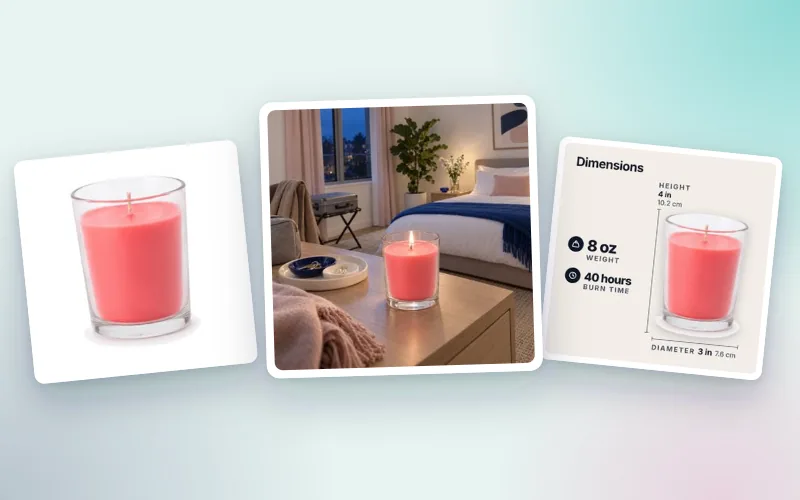
Product photography for marketplace listings: the shot list for every image slot
The photos to take of any product so every marketplace image slot can be filled: the shot list, light and background with what you have, the angles each marketplace asks for, and how to photograph labels so they stay readable.
Guide · 10 min read
AI product photography without misrepresenting your product: what is safe to make
Where AI product images misrepresent a product, the two ways to make them safely, which image slots suit an AI scene and which must stay a photo, the marketplace rules on AI images, and a check to run before you publish.
Guide · 10 min read
How to take product photos at home that work on every marketplace
How to take product photos at home with a phone that meet every marketplace's image rules: the settings that matter, window light and a white card, the photos to take in order, labels and textures, and the mistakes that cost a reshoot.
Guide · 10 min read